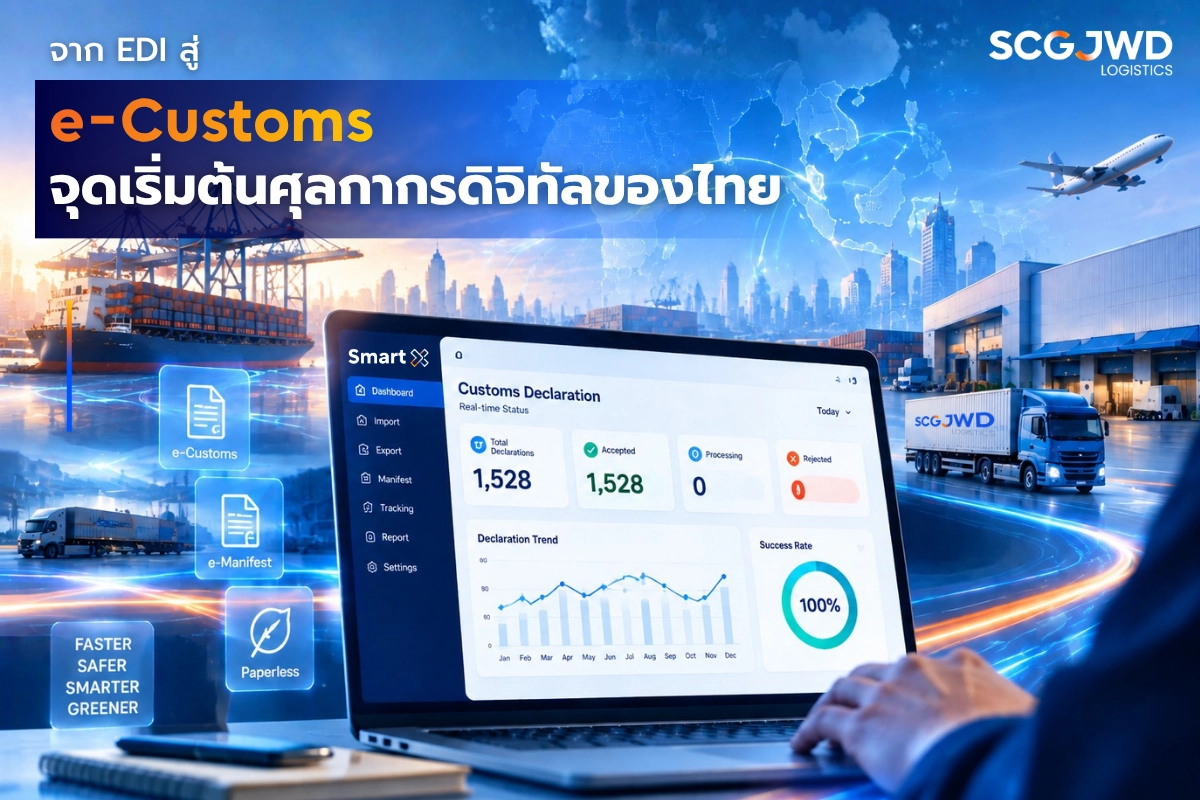
From Electronic Data Exchange to Digital Customs Transformation
In the past, Thailand’s import and export processes relied heavily on paper-based documentation, including data preparation, document submission, and coordination between businesses and relevant authorities.
As international trade volumes continued to grow, speed, accuracy, and data connectivity became key factors in developing more efficient customs processes.
One of the significant milestones was the adoption of EDI (Electronic Data Interchange) as the foundation for electronic data exchange, which later evolved into e-Customs — transforming Thailand’s customs procedures into a fully digitalized process.
The Beginning of Digital Transformation: From Paper-Based Processes to EDI
What is EDI?
EDI (Electronic Data Interchange) is the electronic exchange of business information between the systems of businesses and relevant organizations.
Before the adoption of EDI, most import and export processes relied on paper documents and manual data entry, which required significant time and created potential risks of errors.
The implementation of EDI enables standardized data exchange between systems, reducing manual processes and improving the speed and efficiency of operations.
The Role of EDI in Thailand’s Customs Development
The adoption of EDI represented a significant step forward by shifting the approach from “document exchange” to “system-to-system data exchange.”
This transformation established an important foundation for the future development of Thailand’s digital customs ecosystem.
Key benefits of EDI include:
- Reducing paper-based documentation in import and export processes
- Minimizing repetitive data entry
- Improving data accuracy
- Enabling faster information exchange among relevant parties
- Supporting integration with enterprise information systems
From EDI to e-Customs: The Transformation Toward Paperless Customs
As technology and international trade continued to evolve, the Customs Department further developed the system from EDI into e-Customs.
e-Customs, or the electronic customs clearance system, applies digital data to replace traditional paper-based customs procedures.
This transformation enables key customs processes, including:
- Submission of customs declaration information
- Data verification
- Customs clearance procedures
- Receiving customs processing results
to be conducted through electronic systems with greater efficiency.
What is the Difference Between EDI and e-Customs?
Although EDI and e-Customs are closely related, they serve different purposes.
| EDI | e-Customs | |
| Main Role | Exchange of data between systems | Digital customs clearance process |
| Purpose | Standardized electronic data exchange | Conducting customs procedures through electronic systems |
| Example | Transmitting customs declaration information | Data verification and paperless customs clearance |
In simple terms:
EDI is the foundation for connecting and exchanging data.
e-Customs is the digital customs process that utilizes electronic data.
From e-Customs to a Connected Digital Customs Ecosystem Across the Supply Chain
The development of customs systems has gone beyond simply reducing paper usage. Today, it focuses on connecting data across all stakeholders through concepts such as Single Window and National Single Window (NSW).
This enables supply chain participants to operate with more connected and accessible information, including:
- Importers and exporters
- Freight Forwarders
- Customs Brokers
- Logistics service providers
- Government agencies
Digital Customs and the Future of Import-Export Businesses
Today, Digital Customs is no longer only about replacing paper documents with online data. It represents the creation of a connected ecosystem where information can flow seamlessly among all stakeholders.
This enables businesses to:
- Improve operational speed
- Reduce errors from manual processes
- Increase data visibility
- Support future supply chain growth
SCGJWD’s Role in Supporting the Digital Customs Ecosystem
In an era where data has become a key driver of supply chain performance, systems that enable seamless data connectivity and support customs operations play an increasingly important role.
SCGJWD has developed Smart-X EDI Service to support import-export data connectivity, including e-Customs, e-Manifest, and Paperless Customs processes.
The solution helps businesses manage customs-related information more conveniently, efficiently, and accurately, enabling smoother digital workflows across import-export operations.
Conclusion
The journey from EDI to e-Customs represents more than a change in data transmission methods. It marks the beginning of Thailand’s transition toward digital customs transformation.
From reducing paper-based processes to connecting data across stakeholders, this evolution continues to drive the future of a Connected Supply Chain.