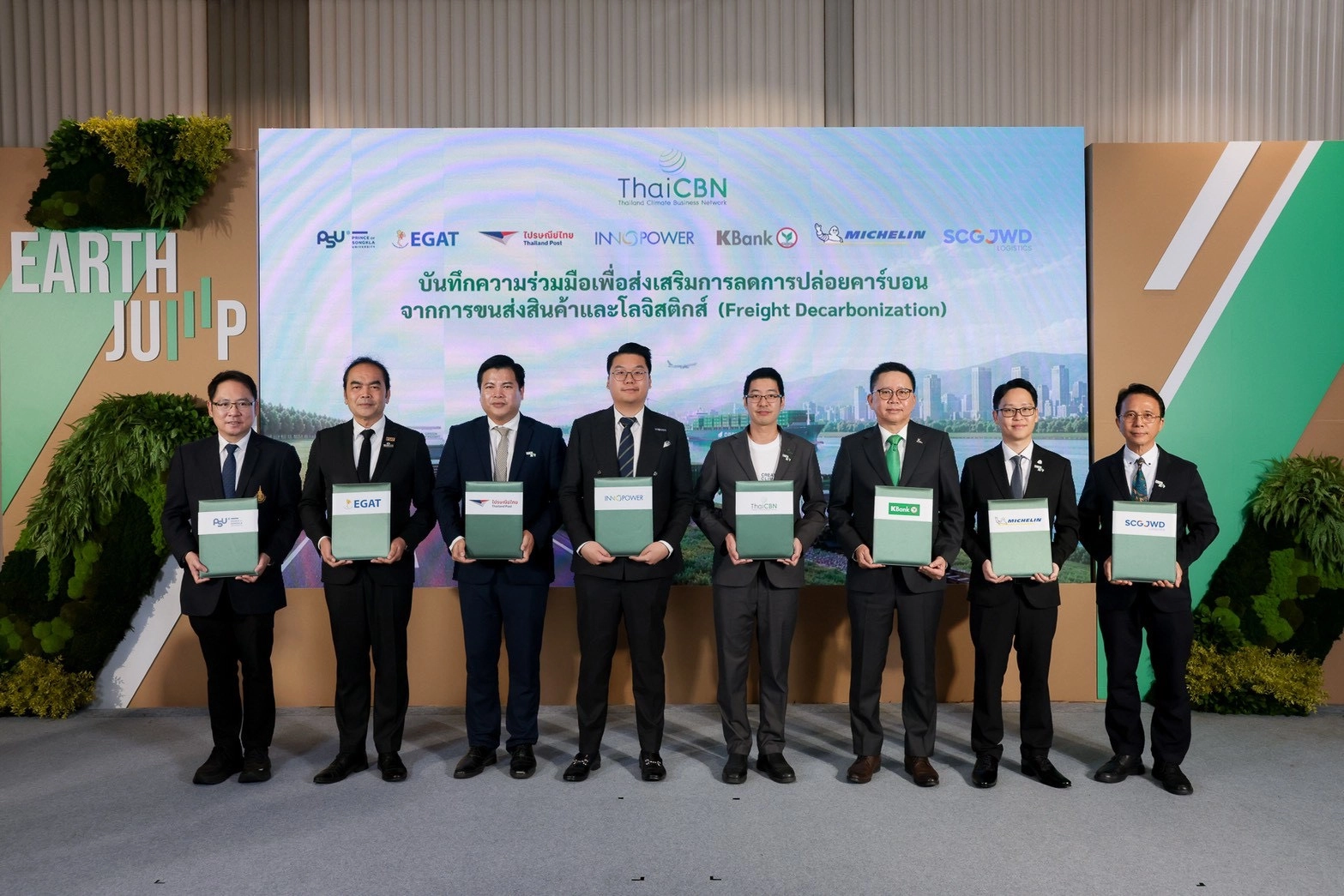
SCGJWD Signs Green Freight MOU at EARTH JUMP 2026
SCGJWD is driving the transition toward a low-carbon economy by signing a Memorandum of Understanding (MOU) on Green Freight at EARTH JUMP 2026. The initiative aims to concretely reduce greenhouse gas emissions in Thailand’s logistics and transportation sectors through collaboration with seven leading organizations under the Thailand Climate Business Network (ThaiCBN), including Prince of Songkla University, the Electricity Generating Authority of Thailand (EGAT), Thailand Post Co., Ltd., Innopower Co., Ltd., Siam Michelin Co., Ltd., and SCGJWD Logistics Public Company Limited. These partners are working together under ThaiCBN’s Green Freight group to develop carbon reduction approaches in logistics and transportation through knowledge sharing, technology, clean energy solutions, and multi-sector support mechanisms.
The Transportation Sector’s Critical Role in Reducing Greenhouse Gas Emissions
The transportation sector is a major source of greenhouse gas emissions in Thailand, accounting for approximately 29% of the country’s final energy consumption and relying on fossil fuels for more than 95% of its total energy use. Road transportation, the primary mode of transport, represents over 96% of energy consumption within the sector. As a result, transportation and logistics play a critical role in helping Thailand achieve its climate goals.
Under Thailand’s latest Nationally Determined Contribution (NDC), the country aims to reduce greenhouse gas emissions from the transportation sector by approximately 22.6 million tonnes of carbon dioxide equivalent (MtCO₂e) by 2030. While long-term measures such as electric vehicles, alternative fuels, and modal shifts are essential, they require significant investment, infrastructure development, and readiness among industry stakeholders.
Green Freight Is More Than EV Adoption—It Is About Optimizing the Entire Logistics System
Therefore, Green Freight is not solely about replacing conventional vehicles with EVs. It also focuses on operational improvements that can be implemented immediately, such as increasing load utilization, reducing empty trips, optimizing route planning, and leveraging data-driven management. These measures can reduce fuel consumption and greenhouse gas emissions by approximately 10–30%, while also lowering costs and enhancing business competitiveness.
Developing a Low-Carbon Transportation Transition Model
The Green Freight group under ThaiCBN is therefore focused on developing a “Low-Carbon Transportation Transition Model” that connects national climate objectives with practical business operations. The model encourages operators to begin with accessible, high-impact measures in the short term while preparing for long-term transitions in energy and technology.
Action-Oriented Collaboration to Drive Thailand Toward Net Zero
This Green Freight collaboration serves as another example of Action-Oriented Collaboration under ThaiCBN, transforming partnerships into tangible actions. The initiative supports improvements in Thailand’s logistics efficiency, strengthens business competitiveness, and contributes to the country’s long-term Net Zero ambitions.
Follow Green Freight Initiatives and ThaiCBN Activities
Logistics operators, transportation companies, and businesses with transportation activities in their supply chains that are interested in Green Freight approaches, pilot projects, or collaborative initiatives under ThaiCBN can follow updates and find more information on the ThaiCBN website.